Green Hydrogen Production |
HydSun Community Energy Parks
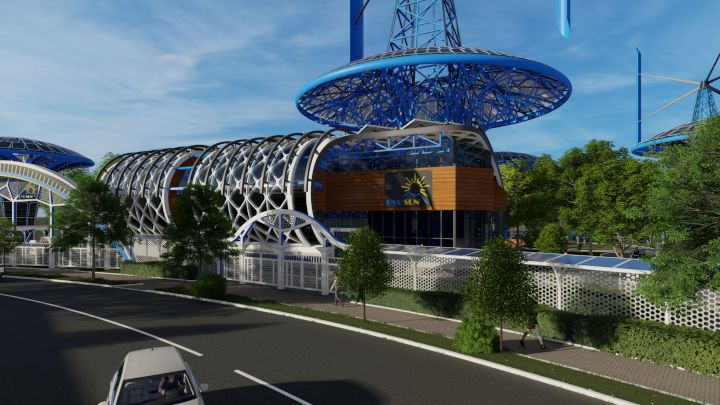
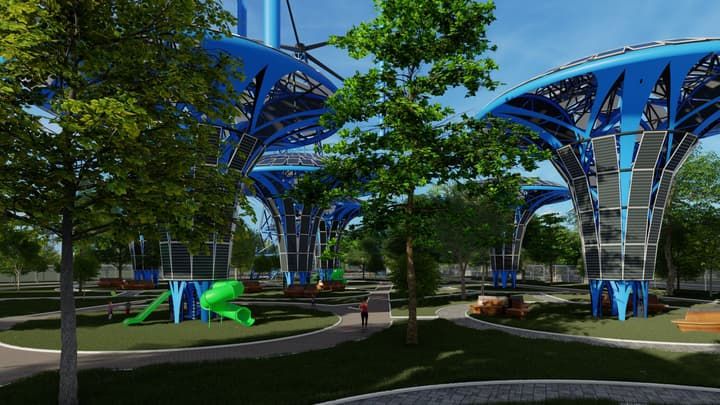
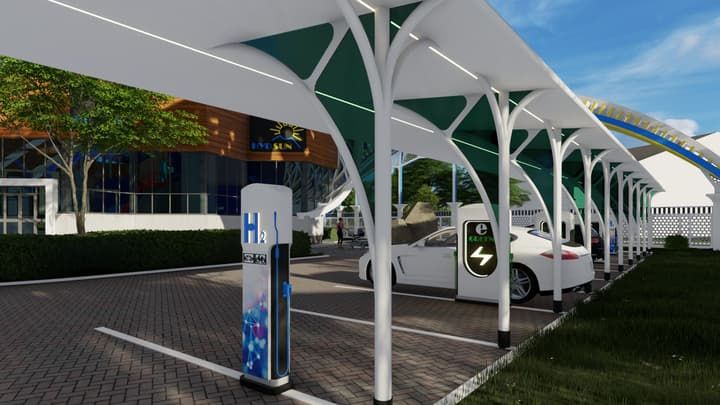
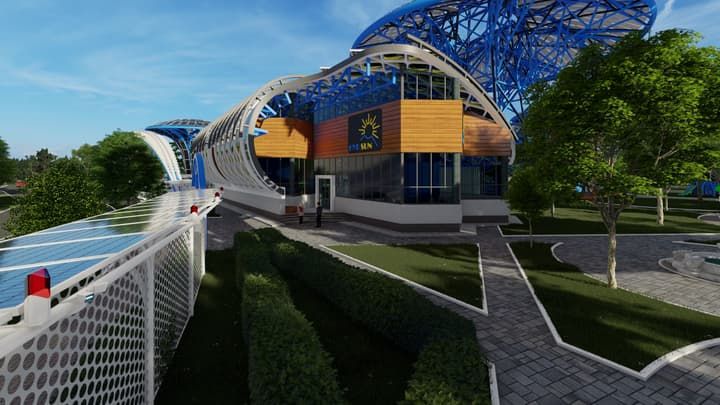
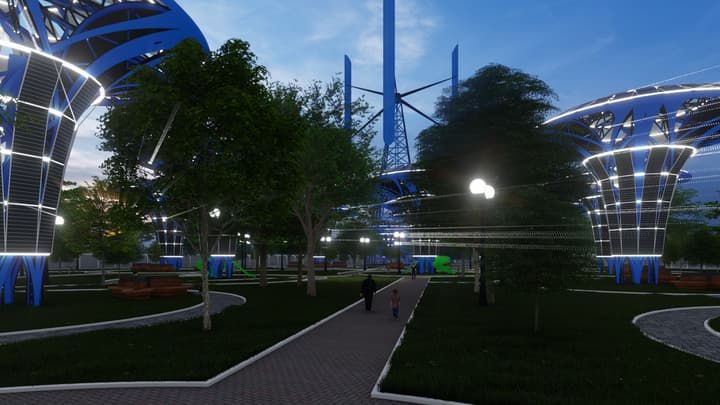

Community Energy Park «HydSun»
Technical Fundamentals of Green Hydrogen Production
What is green hydrogen? Green hydrogen (H₂) is a low-carbon energy carrier produced via Proton Exchange Membrane electrolysis (PEM) from demineralised water using renewable electricity. In the production of green hydrogen through water electrolysis, ultra-pure hydrogen (99.999% purity) and oxygen (O₂) are generated; oxygen can be processed to meet medical-grade/pharmacopoeia specifications where permitted and subject to licensing and quality systems. At the point of electrolysis, no CO₂ is emitted. The overall climate impact depends on the electricity source and system boundaries. How is green hydrogen produced? Through state-of-the-art PEM electrolysers with efficiency up to 85%, powered by photovoltaically generated solar electricity, the electrochemical splitting of water (H₂O) into its molecular components occurs.
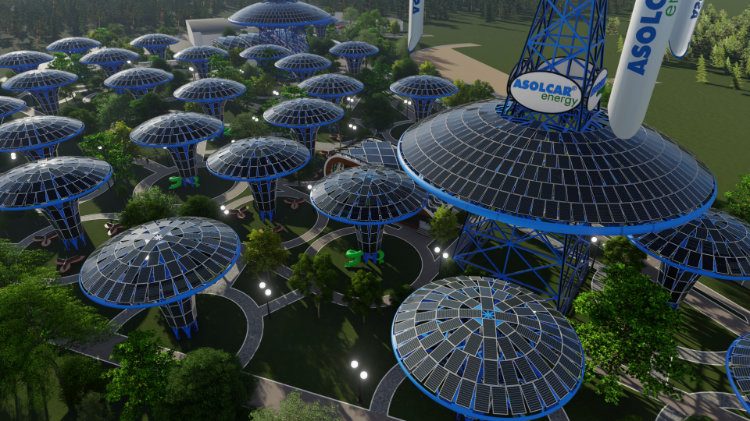
The investment project «HydSun» integrates green hydrogen production in Germany with innovative solar tree technology and decentralised energy infrastructure. Our HydSun Community Energy Parks implement modular PEM electrolysis systems to produce both green hydrogen (purity 5.0) and oxygen designed to meet pharmacopoeia/medical-grade specifications (where permitted and subject to project qualification, licensing and quality systems). The green hydrogen production Germany is resource-efficient from treated rainwater or desalinated seawater via reverse osmosis. As a B2B partner, we offer technical gases for industrial applications and provide information on oxygen supply solutions for healthcare providers and homecare services via authorised channels (subject to applicable licensing, prescription requirements, and local regulation).
Expertise and Project Development
Strategic Site Planning for Decentralised Hydrogen Production
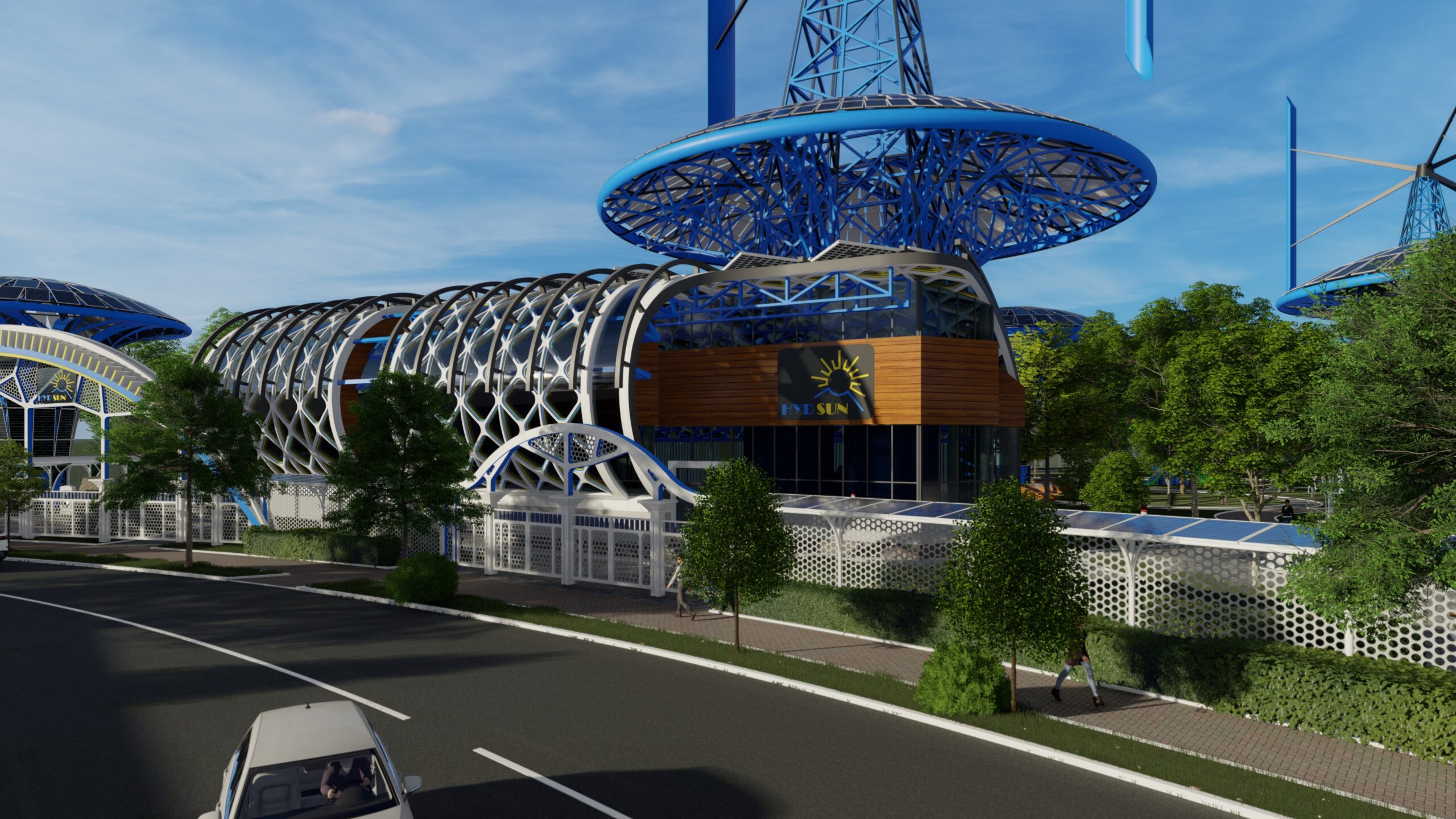
As technology owner and system developer, Dipl.-Ing. Wilhelm Brull is planning the realisation of a pilot project on an available industrial site in the city of Rees (North Rhine-Westphalia) for this forward-looking, socio-economically and ecologically sustainable energy infrastructure. In cooperation with municipal decision-makers and institutional investors, an integrated Community Energy Park for the production of green hydrogen with an attached research and demonstration facility is to be established there.
HydSun Parks are designed as modular, scalable systems for various site configurations in Germany and internationally. The green hydrogen production is decentralised and flexibly scalable from 100 kW to multi-MW systems.
Optimal site profiles for HydSun Energy Parks include: industrial areas, commercial parks, hospitality and catering businesses, retail parking areas, logistics centres, freight transport hubs, motorway service stations and large-scale agricultural operations. The decentralised on-site production of technical gases (hydrogen H₂ and oxygen O₂) eliminates transport costs and optimises the value chain.
Municipal sewage treatment plants and water treatment infrastructure offer excellent synergy effects for industrial HydSun Parks. The integration of facilities for production of green hydrogen and medical oxygen enables process optimisation, energy cost reduction and significantly increases overall operational efficiency.
HydSun Community Energy Parks: Multifunctional Energy Infrastructure with Social Added Value
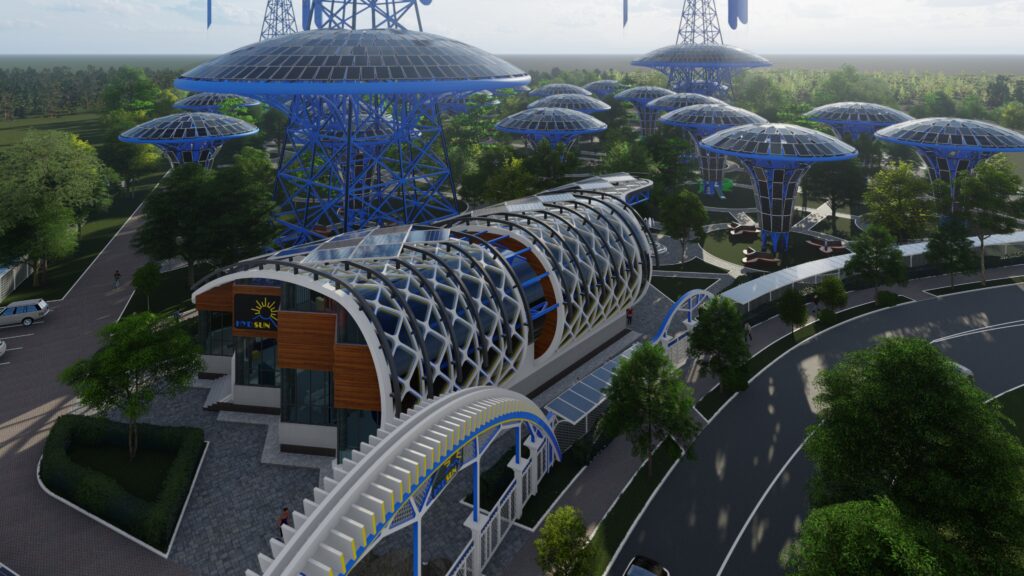
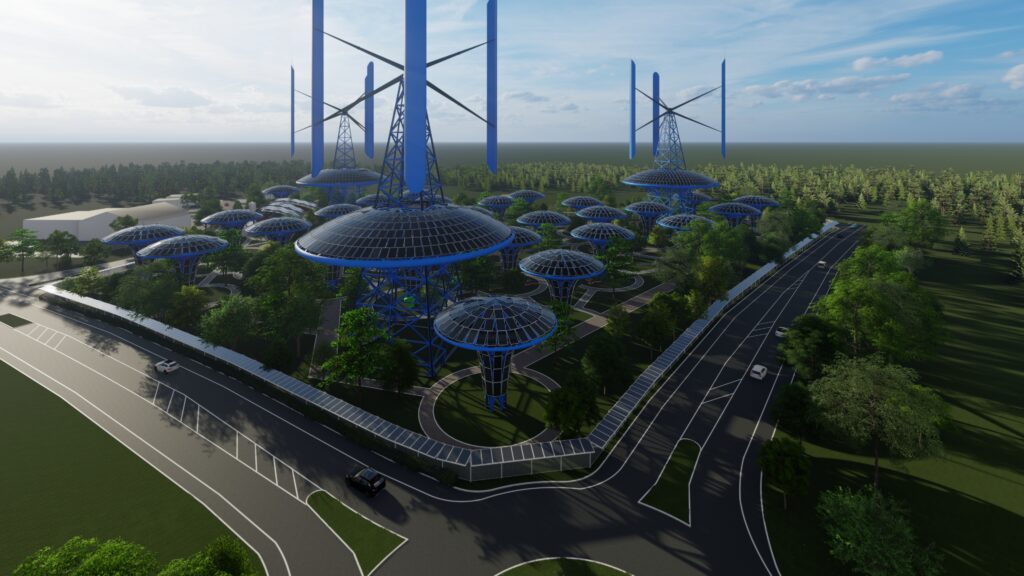
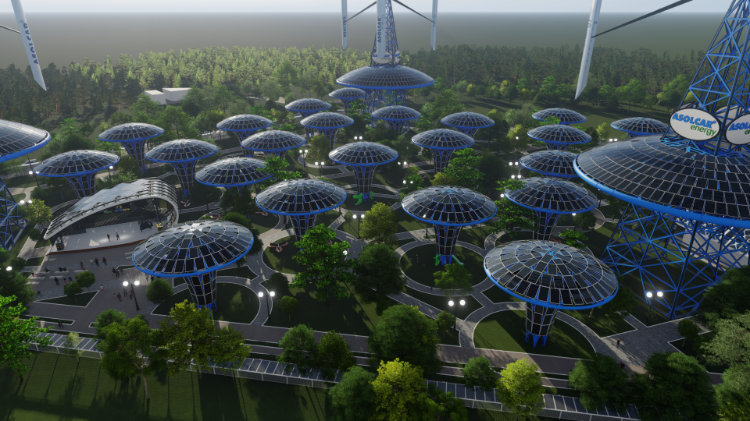
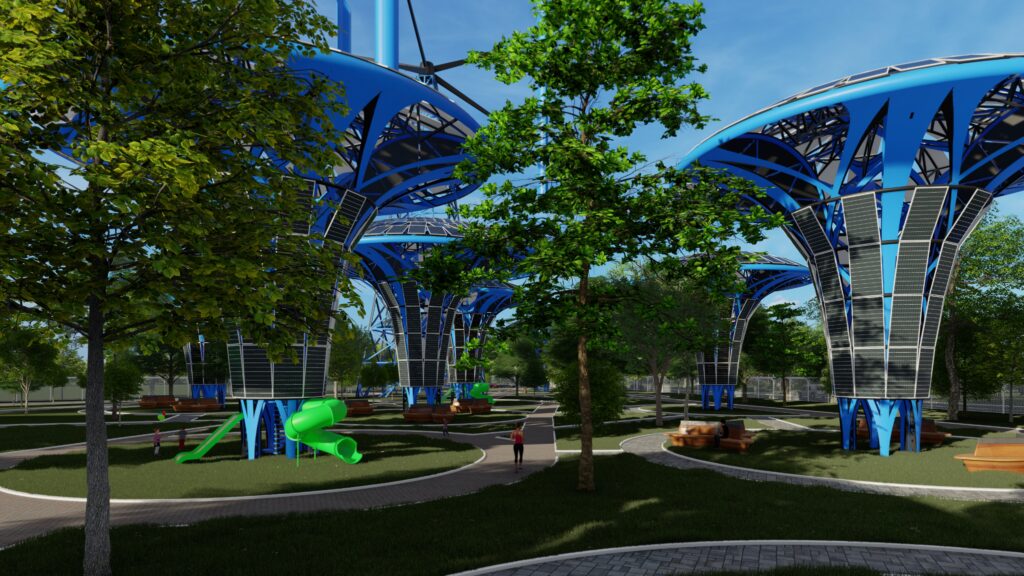
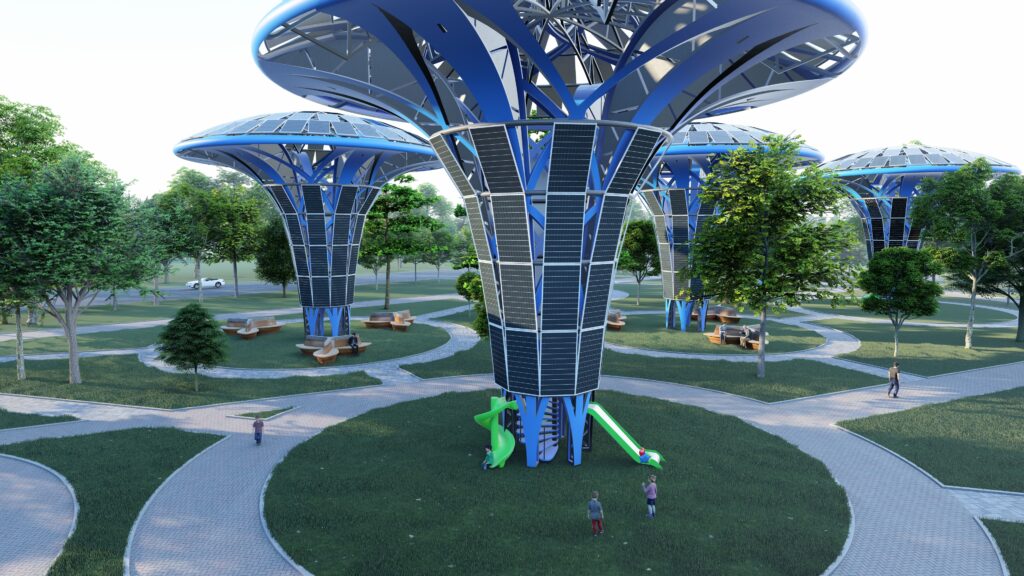
The integrated hydrogen solar parks of the «HydSun» concept combine industrial energy production with publicly accessible recreational infrastructure according to the principle of „social acceptance through participation“. While the electrolysis systems produce green hydrogen, extensively landscaped park areas, semi-natural biotopes and recreational zones create an attractive environment for citizens and promote biodiversity according to EU taxonomy criteria.
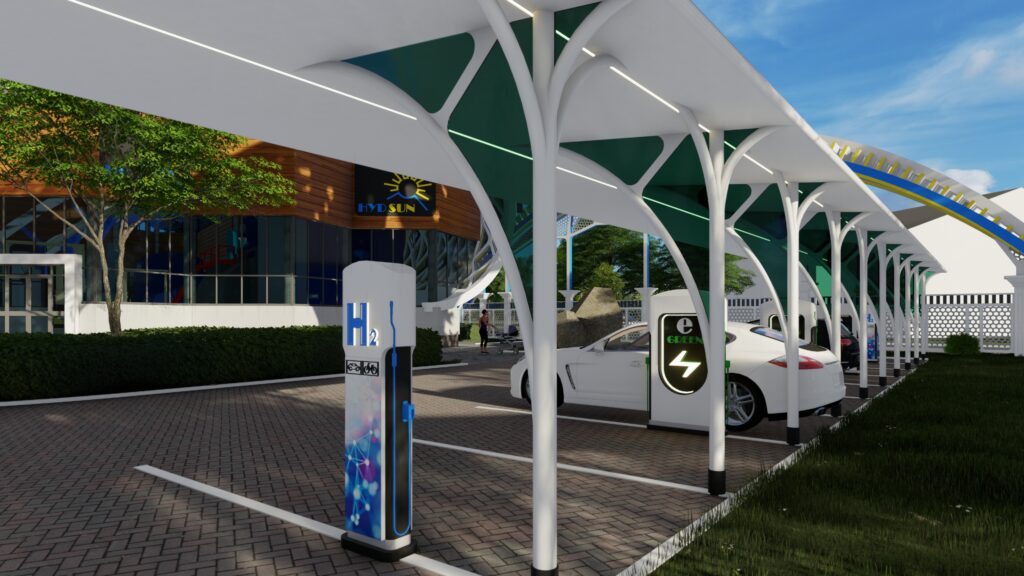
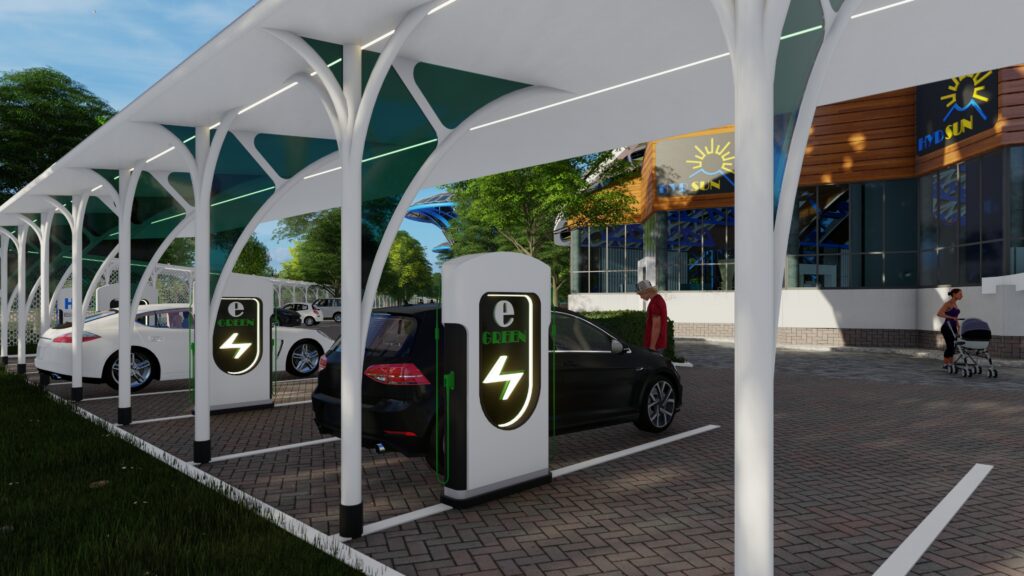
Each solar tree in the HydSun Energy Park functions as a decentralised energy node with integrated charging infrastructure: inductive and conductive charging stations for electric mobility (e-bikes, e-scooters, cars according to Type 2 standard), USB-C fast charging points and 230V Schuko connections. The completely self-sufficient energy supply is photovoltaic with buffer storage (lithium-ion technology).
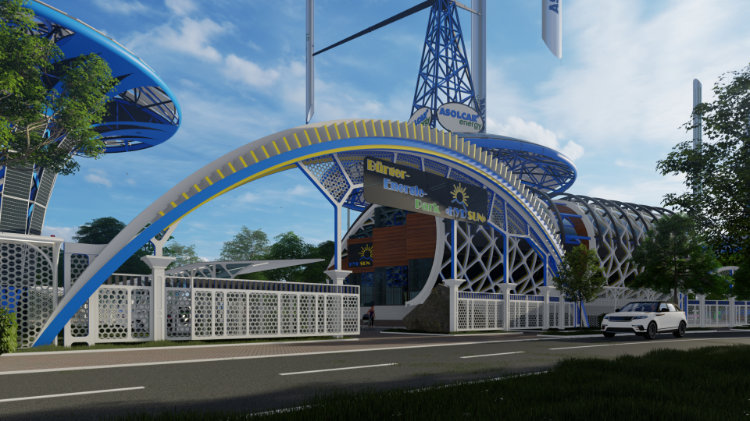
A fully automated H₂ refuelling station with SAE J2601-compliant dispensers (350 bar and 700 bar) is an integral part of every electrolysis system. In parallel, the pharmaceutical processing, pressure storage (up to 300 bar) and filling of oxygen according to pharmacopoeia standards (Ph. Eur.) takes place. Information about cylinder refilling and oxygen supply (including portable use cases) is provided for qualified customers and partners, subject to applicable licensing, prescription requirements, and local regulation.
Passive and active climate control concepts ensure thermal comfort: shading systems through solar tree canopies reduce summer overheating by up to 8°C, whilst heat recovery from electrolysis processes (waste heat at 60-80°C) and optional hydrogen fuel cell CHP provide winter energy supply. An IoT-based Energy Management System (EMS) with predictive AI control continuously optimises green hydrogen production and all energy flows in the park.
Proprietary Solar Tree Technology: Patented Photovoltaic Architecture
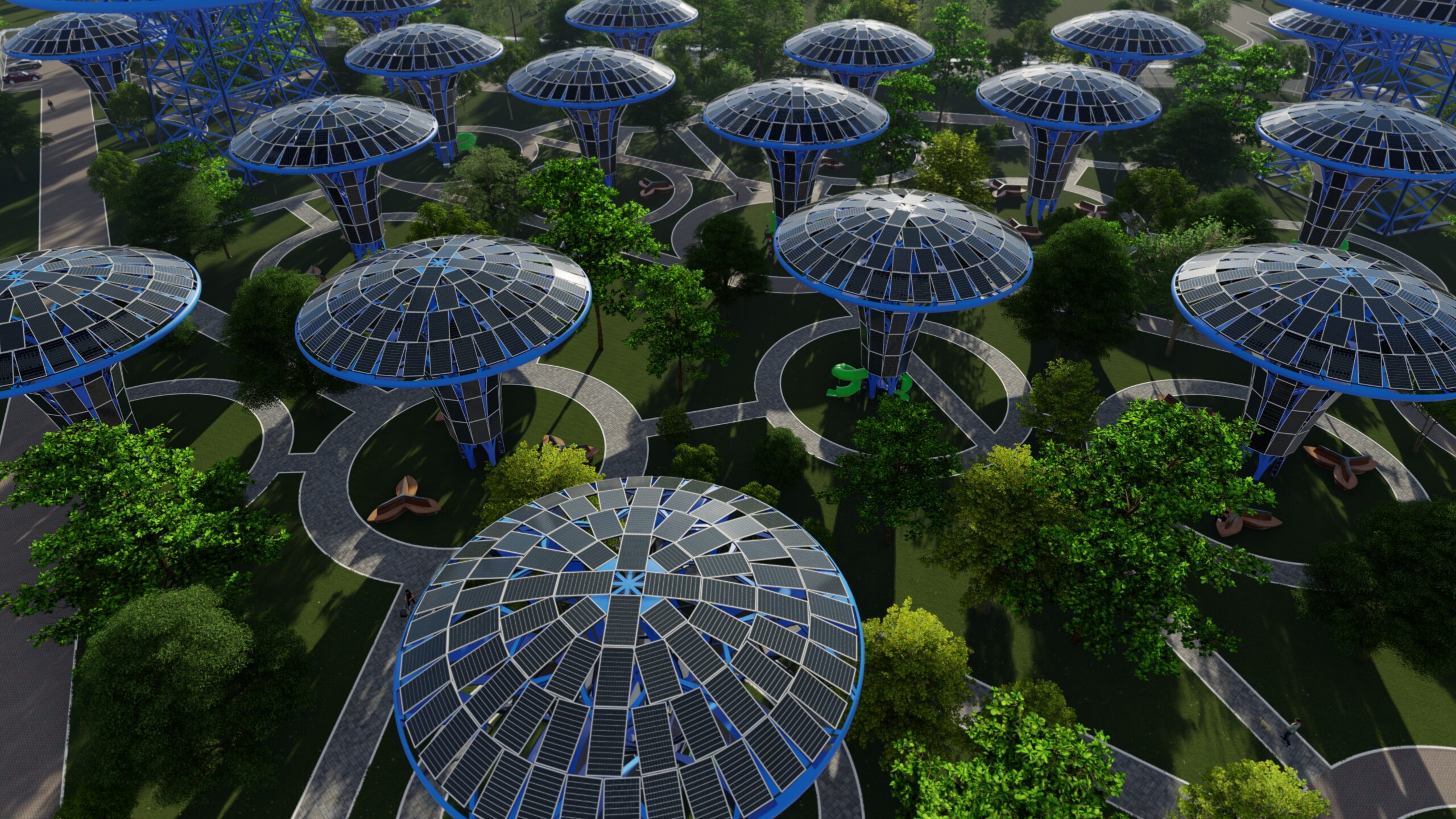
To realise this highly efficient, space-optimised power generation for green hydrogen production, Dipl.-Ing. Wilhelm Brull developed a globally unique solar tree technology: three-dimensional photovoltaic structures with bifacial high-performance modules (efficiency >22%), achieving 40% higher area efficiency compared to conventional ground-mounted systems.
The biomimetic construction of solar trees ensures optimal light transmission for ground vegetation (PAR transmission 35-45%) and creates microclimatic zones. Selective shading reduces evapotranspiration by 60% and protects ecosystems from thermal stress (ΔT down to -8K). This design fulfils the EU climate adaptation strategy and national heat protection plans whilst enabling agricultural dual use (Agri-PV according to DIN SPEC 91434).
Holistic System Design: Energy Autonomy, Ecology and Security of Supply
An AI-supported Precision Irrigation System (PIS) with soil moisture, temperature and evapotranspiration monitoring optimises the irrigation of park vegetation from cisterns, deep wells and rainwater retention basins. Machine learning algorithms precisely predict water requirements and reduce consumption by up to 45% compared to conventional systems. The energy supply for pump infrastructure is completely from autonomous solar power from the park’s internal microgrid.
Optional thermal leisure infrastructure (swimming pools, wellness areas) can be efficiently heated using heat recovery from electrolysis processes (process heat 60-80°C) or through hydrogen fuel cell CHP modules (electrical efficiency 50-60%, thermal 30-40%). This sector coupling maximises overall system efficiency to over 90%.
LED lighting infrastructure (CCT 3000-6500K, dynamically controllable) is supplied via DC-coupled battery storage (LiFePO₄ technology, 80 kWh per solar tree). A circadian lighting management system with twilight sensors, motion detectors and AI-based prediction logic reduces energy consumption by 75% compared to conventional systems whilst minimising light pollution (Dark Sky compliant).
Application Spectrum and Market Potential of Green Hydrogen
What is green and blue hydrogen? The colour coding differentiates production methods: Green hydrogen is produced via electrolysis with renewable electricity (solar, wind, hydro) and has no direct CO₂ emissions at point of use; life-cycle emissions depend on electricity sourcing and system boundary. Blue hydrogen is based on steam reforming of fossil fuels (natural gas, CH₄) with downstream Carbon Capture and Storage (CCS), but exhibits systemic CO₂ leakage. Turquoise hydrogen uses methane pyrolysis with solid carbon as a co-product. Only green hydrogen fulfils the EU taxonomy for sustainable investments and is central to decarbonising hard-to-electrify sectors. Primary application domains include:
Mobility Sector:
- Fuel Cell Passenger Cars (FCEV) – Zero tailpipe emissions (at point of use)
- Commercial Vehicles & Logistics – Trucks, vans (>3.5t)
- Maritime Applications – Ferries, inland and ocean-going vessels
- Heavy Machinery – Construction, mining and agricultural vehicles
- Public Transport Fleets – Fuel cell buses
- Light Mobility – E-bikes with range extenders
Energy Infrastructure:
- H₂ Refuelling Networks – 350/700 bar infrastructure
- Stationary Fuel Cells – Combined Heat and Power (CHP)
- Grid Stabilisation – Power-to-Gas (P2G), sector coupling
- Emergency Power Supply – UPS systems, backup power
- Energy Storage – seasonal long-term storage
- Reconversion – Combined Cycle Gas Turbines (CCGT)
Heat Supply through Green Hydrogen: Sector Coupling for Industry and Property
The energy carriers produced in «HydSun» hydrogen solar parks address both large industrial customers and commercial and residential end users with scalable supply concepts.
Distribution occurs either via existing natural gas networks (H₂ admixture up to 20 vol.%, prospectively 100% H₂-ready) or via mobile trailer stations (tube trailers, 500 bar, 1,000 kg H₂ capacity). H₂-capable fuel cell heating appliances (Solid Oxide Fuel Cells – SOFC, Polymer Electrolyte Fuel Cells – PEFC) enable heat and power generation with no direct CO₂ emissions at point of use when operated on green H₂ (life-cycle emissions depend on electricity sourcing and system boundary) in decentralised CHP configurations with electrical efficiencies of 50-60% and overall efficiencies exceeding 90%.
Intelligent Energy Management Systems (EMS) with load profile analysis and predictive control optimise bidirectional energy and heat supply. Integration into smart grids enables demand-side management, peak shaving and facilitates lucrative business models in the balancing energy market.
The co-product demineralised water (conductivity <0.1 µS/cm) finds diverse technical applications in laboratories, industrial processes, battery manufacturing and as a cleaning agent in pharmaceuticals and food production.
Industrial Hydrogen Use: Competitive Advantages through Decentralised On-Site Production
In light of volatile natural gas markets and rising CO₂ certificate prices in the EU-ETS, green hydrogen from HydSun Parks offers significant cost advantages: production costs of 4-6 €/kg H₂ (target: <3 €/kg by 2030) will prospectively undercut fossil alternatives. Feed-in to existing gas infrastructure (certified according to DVGW G 260-1) enables seamless integration without capital-intensive new investments.
Logistical value creation through proximal on-site production: trailer-based H₂ distribution (Type-I to Type-IV pressure vessels, LOHC systems) or pipeline connection minimise transport costs by up to 60% compared to centralised large-scale plants. Delivery times are reduced from days to hours, enabling just-in-time supply concepts.
In CHP applications, H₂ converts with overall efficiencies >90% into electricity and process heat. The simultaneous availability of both energy forms significantly optimises industrial production processes. Hydrogen also enables load shifting and grid services that generate additional revenue streams.
Flexible blending: H₂ admixture to natural gas (0-100 vol.%) is technically realised with adaptable infrastructure. This extends application possibilities to existing facilities and enables gradual decarbonisation without disruptive system changes.
Hydrogen-Based Reconversion: Flexible Capacities for Energy System Transformation
Solar-electrolytically produced green hydrogen at generation costs of 4-6 €/kg enables dispatchable power generation as a system-critical complement to fluctuating renewable energies. Fuel cell CHP plants (SOFC/PEMFC, 50-60% el. efficiency) or H₂-ready Combined Cycle Gas Turbines (CCGT, 60-65% efficiency) substitute fossil baseload and peaking plants economically from a CO₂ price of 80-100 €/t.
Hydrogen Production for Medicine and Therapy
Gas is becoming increasingly expensive. Hydrogen, which will be produced in an environmentally friendly manner in our parks in the future, can also be made available to industry via old, tested gas pipelines as a cost-effective and environmentally friendly alternative energy source to more expensive gas.
Modern hydrogen transport of various types also enables deliveries of large quantities of hydrogen to industrial customers. The nearby production from HydSun Parks in close proximity noticeably reduces delivery costs and delivery time.
Electricity is produced as the main product from hydrogen. Heat is added as a „by-product“. Demand-oriented individual design of energy supply through hydrogen use brings particularly efficient gas consumption that was hardly conceivable with natural gas.
The use of hydrogen as a single fuel or as an admixture to natural gas is feasible through existing innovative solutions and enormously expands the possible areas of application for this product.
Generate Electricity with Green Hydrogen
With hydrogen produced economically in the future through solar power and electrolysis from well water, a genuine alternative to today’s expensive power generation by gas and coal power plants is created.
Hydrogen Production for Medicine and Therapy
Research is exploring potential applications of hydrogen in medicine and therapy. Evidence levels, indications, and regulatory approvals vary by jurisdiction and product type:
- Medicine of the Future? – Molecular or Free Hydrogen against Oxidative Stress
- Hydrogen Gas for Therapy and Prevention
- Hydrogen – More than Just a Therapy | Natural Medicine | QS24 Health Television
The green hydrogen obtained in our parks is designed for high purity and may be suitable as an input for medical/technical applications where relevant standards and regulatory approvals are met. This website does not make medical efficacy claims.
Any medical use must be coordinated with appropriately licensed healthcare professionals and must comply with applicable medical device/medicinal product regulations.
Our wish is that every certified, recognised and licensed therapist or naturopath finds a place for their practice or facility in our HydSun Parks.
How Can Oxygen Be Used?
Since oxygen is known as an oxidising agent, many different areas of application are possible. From respiratory support in healthcare to melting processes in the steel industry, from food production and processing to wastewater treatment, from pharmaceutical manufacturing to waste recycling – oxygen is used everywhere. We provide information on medical oxygen supply options and O2 cylinders for qualified customers and partners (subject to applicable law).
Medical-Grade Oxygen: Pharmacopoeia Specifications (Ph. Eur.), Where Permitted
The medical oxygen (O₂ ≥99.5 vol.%, Ph. Eur. 0417) obtained electrolytically in HydSun Parks is designed to meet pharmaceutical quality requirements for therapeutic applications and medical products, subject to site-specific qualification, licensing and quality system implementation. Where required, GMP-related requirements (Good Manufacturing Practice) and approvals must be obtained before any supply for medical use. We work with qualified medical facilities, pharmacies and homecare providers and can provide information about oxygen supply solutions for homecare use via authorised channels. Medical oxygen is commonly prescribed for conditions such as COPD, pulmonary fibrosis, cardiac diseases and post-COVID syndromes; indications, dosing and patient suitability must be determined by licensed clinicians.
Medical applications and dosages are subject to medical prescription according to AMG §21 (where applicable). Any refilling and supply services for medical oxygen require the relevant approvals and quality systems (including batch documentation and traceability) in the applicable jurisdiction.
Industrial Oxygen: Competitive Advantages through On-Site Availability
Industrial oxygen (tech. O₂ ≥99.5%, purities up to 99.999%) is a critical input factor for oxidative and thermal processes. Electrolytic O₂ from HydSun Parks offers cost advantages of 20-40% compared to cryogenic air separation (ASU) at off-take volumes <50 t/day. We supply technical gases in compressed gas cylinders (200 bar), liquid oxygen (LOX, -183°C) or via pipeline for process-integrated applications.
Core segments for industrial oxygen: Food industry (fumigation, ozonation), pharmaceutical industry (fermentation, oxidation), steelworks (oxyfuel technology, EAF processes), thermal waste treatment (MVA efficiency enhancement), recycling industry (pyrolysis), building materials industry (glass melting, cement production), chemicals (ethylene oxide, propylene oxide), paper industry (bleaching), aquaculture (oxygen enrichment).
The European oxygen market (>15 million t/a) is growing at 4-6% p.a. Demand exceeds nitrogen volume and exhibits significant supply gaps, particularly in industrial clusters and structurally weak regions without ASU infrastructure.
Oxygen for Municipalities
Municipalities can benefit from the oxygen obtained cheaply in the parks, as it is needed, for example, in sewage treatment plants to clean wastewater in an energy-saving and efficient manner.
There is also the possibility of using the oxygen obtained in «HydSun» hydrogen solar parks for ozone production in swimming pools and municipal baths to drastically reduce the chlorine quantities for water disinfection. This can make a significant contribution to health.
When ozone is used for very high cleaning effectiveness on wastewater in treatment plants, all trace elements of toxins and pharmaceuticals are eliminated.
HydSun as Integrated Energy Infrastructure and Citizen Participation Model
Investment Project for Sustainable Value Creation and Climate Protection
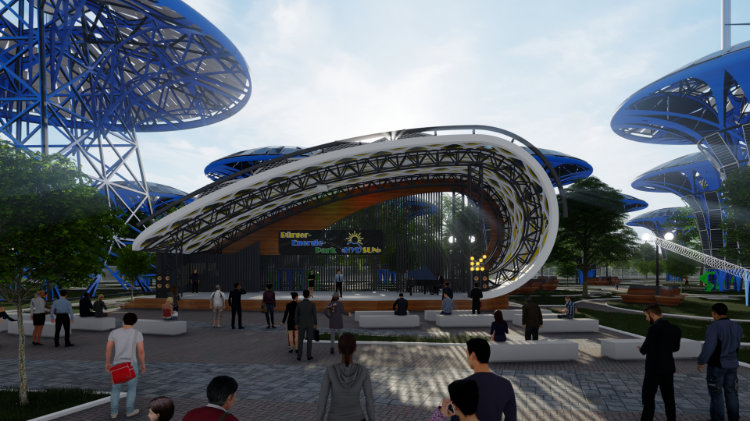
«HydSun» Energy Parks represent a holistic investment model for energy transformation with economic, ecological and social dividends. The simultaneous production of green hydrogen (5-50 t/day, scalable) and publicly accessible infrastructure creates long-term value creation with high stakeholder acceptance.
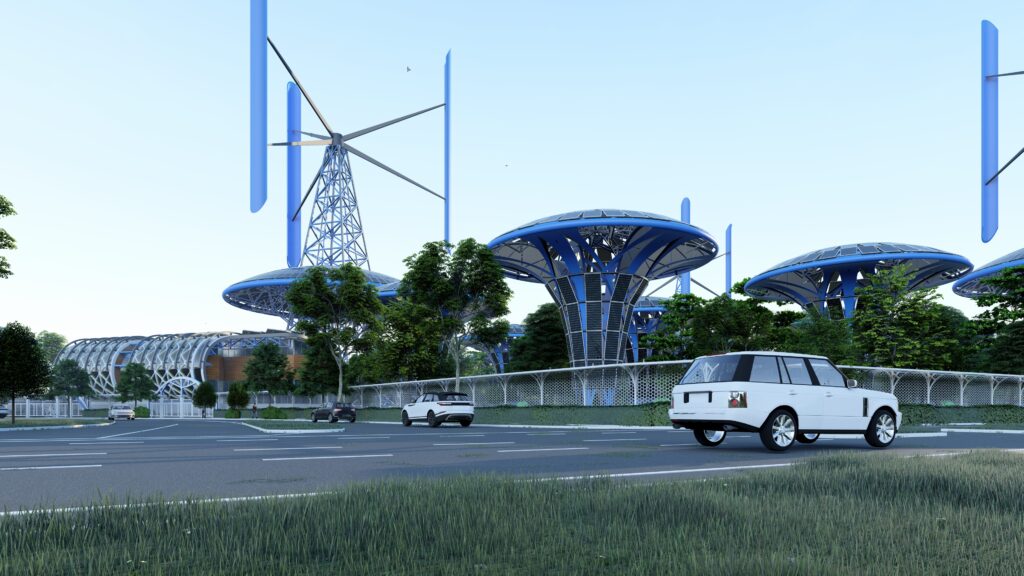
State-of-the-art technologies are implemented according to Best Available Technology (BAT) principles: latest-generation PEM electrolysis, bifacial n-type photovoltaics, AI-supported control systems, sector coupling through power-to-gas and innovative storage solutions. The integration of energy production, leisure infrastructure and cultural offerings creates multifunctional usage concepts with high economic efficiency.
Investment Opportunities and Business Models
We invite qualified investors, industrial partners, municipalities and energy suppliers to inform themselves about strategic participations, joint venture models and long-term supply contracts. Contact us for feasibility studies, ROI analyses and individual project concepts.
Indicative Target Return (IRR): 8-12% p.a. over 20 years (scenario-based, subject to assumptions)
Amortisation: 7-10 years
Financing: Mix of equity, KfW funding, EU funds and project financing
Mission HydSun: Well-being for People and Nature
Our Vision of a Sustainable Future
The HydSun projects by Diplom-Ingenieur, Diplom-Jurist Wilhelm Brull pursue an overarching goal: the improvement of living conditions for people and the regeneration of natural ecosystems. Each realised Community Energy Park measurably contributes to this mission – through clean air, green recreational spaces, climate-resilient infrastructure and decarbonised energy supply.
Positive impacts for people:
• Health: Reduced air pollution through H₂ mobility (-85% particulate matter vs diesel), medical O₂ supply, urban shading and cooling
• Quality of life: Multifunctional recreational spaces with cultural offerings, exercise opportunities and social meeting spaces for all age groups
• Economic security: Long-term employment, reduced energy costs, stable supply independent of geopolitical crises
• Participation: Citizen participation in energy cooperatives enables local co-determination and financial participation in the energy transition
Positive impacts for nature:
• Climate protection: Massive CO₂ savings through replacement of fossil fuels equivalent to the annual sequestration capacity of thousands of trees
• Biodiversity: Semi-natural design with native plants creates habitats for insects, birds and small animals
• Resource conservation: Elimination of fossil fuels reduces environmental burdens from extraction and transport
• Circular economy: Local H₂/O₂ production without transport emissions, sustainable management of natural resources
Mr Wilhelm Brull as initiator develops these technologies from the conviction that innovative engineering solutions can accelerate the transition to a sustainable society. His interdisciplinary expertise (engineering and law) enables holistic concepts that combine technical excellence with regulatory feasibility and social acceptance.
Together we create liveable spaces where people and nature thrive equally – for a future fit for grandchildren.